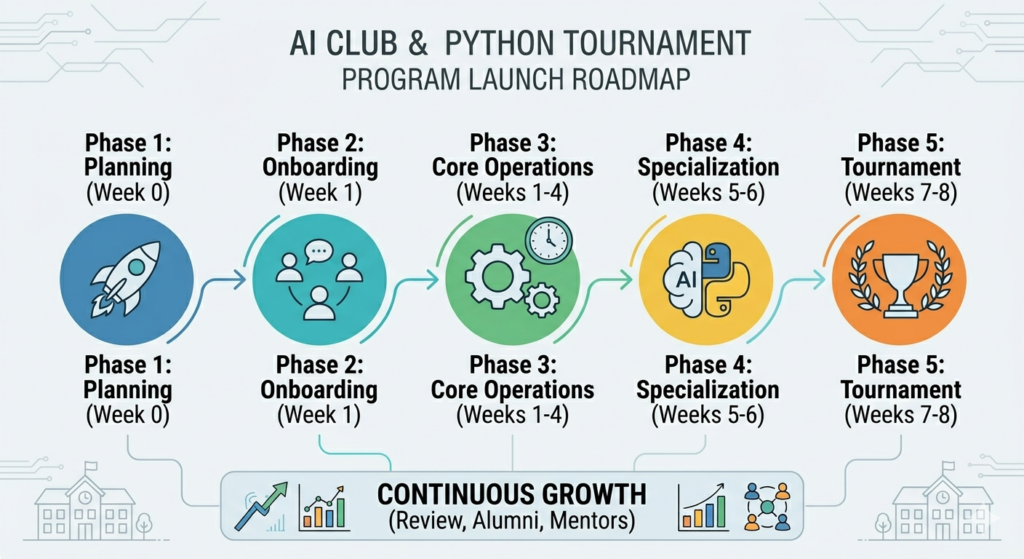
To successfully launch an AI Club and Python Tournament program, it’s best to follow a structured, phased approach—starting with strong foundations and gradually moving into active learning and competition.
Phase 1: Planning and Setup (Week 0)
Before students arrive, focus on building a solid operational framework:
Define the operating model: Set a clear weekly schedule, ideally one session lasting 60–90 minutes.
Set up registration: Use a simple online form to gather student details such as name, grade, and skill level (Explorer, Builder, or Challenger).
Prepare onboarding materials: Create an orientation pack that explains the club’s mission and includes a clear Code of Conduct covering ethical AI use and collaboration.
Establish media channels: Launch a basic website for student profiles and an Instagram page to build visibility and strengthen school branding.
Phase 2: Onboarding and Orientation (Week 1)
The first week should focus on building excitement and setting expectations:
Group students strategically: Organize students based on skill level to keep beginners comfortable and advanced learners engaged.
Run an orientation session: Introduce the concept of a “future-focused ecosystem” and explain the difference between using AI tools and building AI systems.
Communicate with parents: Share a short update outlining the club’s goals, safety and ethics policies, and how participation benefits university applications.
Phase 3: Core Weekly Operations (Weeks 1–4)
Once the club is running, maintain consistency with a repeatable session structure:
Warm-up (10 min): Demonstrate an AI tool or real-world example to spark curiosity.
Learning (25–30 min): Introduce a new concept, such as prompt engineering or basic Python logic.
Practice (20–30 min): Let students apply what they’ve learned through individual or group tasks.
Showcase (10 min): Have students present their work to build confidence and create content.
During this phase, offer two parallel tracks:
Track A: AI literacy (tools, ethics, applications)
Track B: Technical skills (Python coding and problem-solving)
Phase 4: Specialized Training and Skill Building (Weeks 5–6)
As students progress, shift toward deeper skill development:
Launch Python workshops: Run more intensive sessions focused on loops, conditionals, and algorithms to prepare students for competition.
Identify talent: Use these sessions to spot students ready for the “Challenger” level and competitive events.
Phase 5: Tournament Preparation and Execution (Weeks 7–8)
The final phase centers on competition:
Mock competition: Run practice sessions with peer feedback to improve strategy and time management.
Host the tournament: Organize a 60–90 minute event where students solve 5–7 challenges (logic, patterns, debugging) based on their level.
Recognize and retain: Award certificates and prizes, highlight winners on social media, and introduce advanced pathways to keep students engaged.
Continuous Growth Strategy
For long-term success, conduct a monthly review of attendance, engagement, and skill development. At the same time, start building an alumni network by inviting former students to return as mentors or judges—helping create a sustainable, self-growing community.